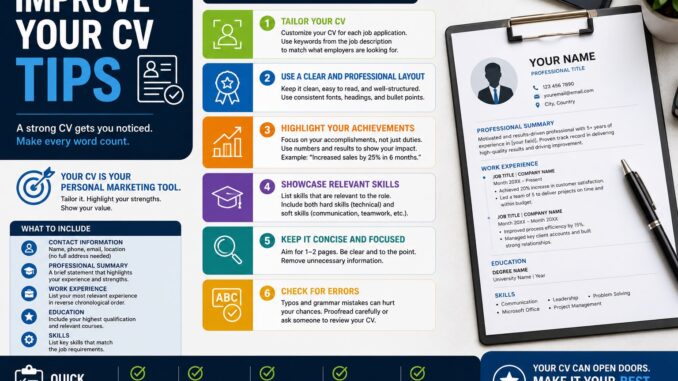
CV Improvements
Your CV is not just a document. It is the first conversation you have with a potential employer before you ever shake a hand, answer a question, or walk through a door. In a country like South Africa, where the competition for jobs is fierce and hiring managers sometimes review hundreds of applications for a single position, the quality of your CV can be the difference between getting an interview and being overlooked entirely. The good news is that improving your CV does not require expensive help or a professional writing service. What it requires is attention, honesty, and a clear understanding of what employers are actually looking for. This guide will walk you through practical, proven tips that will sharpen your CV and give you a stronger chance in any job application process.
Start With the Right Mindset: Your CV Is a Marketing Tool
Many job seekers treat their CV as a history report a list of everything they have ever done. That is not what a CV is. A strong CV is a targeted marketing document. Its one job is to convince a hiring manager that you are worth meeting in person. This shift in thinking changes everything. Instead of asking yourself “what should I include?”, start asking “what does this employer need to see?”. Every section, every bullet point, and every word on your CV should serve that single purpose.
With that foundation in place, let us look at the specific changes that will make the biggest difference.
1. Tailor Your CV for Every Application
One of the most common mistakes job seekers make is sending the exact same CV to every employer. A generic CV signals that you are not particularly interested in the specific role and employers notice. Before you apply for any position, read the job description carefully. Identify the key skills, qualifications, and responsibilities the employer is looking for. Then adjust your CV to reflect those priorities. If the job emphasises customer service, make sure your customer service experience is prominent. If it calls for specific software knowledge, ensure that appears early. You do not need to rewrite your entire CV for each application. Small, deliberate tweaks to your summary, skills section, and the order of your experience can make a significant impact.
2. Write a Powerful Personal Summary
The personal summary sometimes called a professional profile sits at the top of your CV, directly below your contact details. Most people either skip this section entirely or fill it with vague, overused phrases like “hardworking team player with excellent communication skills.” That kind of summary tells an employer nothing they could not assume about any other candidate.
A strong personal summary should be three to five sentences long and answer three questions:
- Who are you professionally?
- What are your strongest skills or areas of expertise?
- What are you looking for in your next role?
Example of a weak summary: “I am a dedicated and motivated individual who works well in a team and is eager to learn.”
Example of a stronger summary: “Retail professional with four years of experience in customer-facing roles across fast-paced store environments. Skilled in stock management, point-of-sale operations, and team coordination. Currently seeking a supervisory position where I can apply my operational knowledge and commitment to excellent service standards.”
The second version is specific, confident, and immediately relevant. That is what you are aiming for.
3. Focus on Achievements, Not Just Duties
When describing your previous work experience, most people list what their job involved the tasks and responsibilities of the role. While that has some value, it is not what makes a CV stand out.
What employers find far more compelling is what you actually achieved in that role.
Instead of writing: “Responsible for serving customers and handling cash.”
Try: “Maintained consistently high customer satisfaction scores and was recognised by store management for accuracy and efficiency during peak trading periods.”
Wherever possible, use numbers and specifics. How many customers did you serve per day? Did you help reduce waiting times? Did sales increase in your department? Did you train new staff members? Concrete results are far more persuasive than a list of duties that any candidate in the same role could claim.
If you are applying for your first job and have no formal work history, focus on achievements from school, volunteer work, community involvement, or any informal work experience you have had.
4. Keep Your CV the Right Length
There is no universal rule, but in most cases a CV should be between one and three pages long. Here is a practical guide:
- No experience or entry-level: One to two pages
- Two to eight years of experience: Two pages
- Senior professional or specialist with extensive experience: Up to three pages
Going beyond three pages is rarely justified and often works against you. Hiring managers are busy, and a bloated CV can suggest that you have not taken the time to identify what is actually relevant.
On the other hand, do not pad a one-page CV with excessive white space or large fonts just to fill the page. Substance matters more than length.
5. Get Your Formatting Right
The visual presentation of your CV matters more than most people realise. A cluttered, inconsistent, or hard-to-read CV creates a poor impression before the employer has read a single word of content.
Follow these formatting principles:
Use a clean, professional font. Stick to readable options like Calibri, Georgia, or Garamond in a size between 10 and 12 points. Avoid decorative or novelty fonts entirely.
Keep formatting consistent. If you bold your job titles, bold all of them. If you use bullet points in one section, use them throughout. Inconsistency looks careless.
Use clear headings. Sections should be immediately identifiable Contact Information, Personal Summary, Work Experience, Education, Skills, References.
Leave adequate white space. Do not cram everything together. A CV that breathes is easier and more pleasant to read.
Save it as a PDF. Unless the employer specifically requests a Word document, always submit your CV as a PDF. This ensures your formatting stays intact regardless of what device or software the employer uses to open it.
6. List Your Skills Strategically
The skills section of a CV is often underused. Many candidates either list generic soft skills (“good communicator, team player, punctual”) that offer no real differentiation, or they dump every skill they can think of without any structure.
A more effective approach is to divide your skills into two categories:
Hard skills — Specific, measurable abilities: operating a forklift, using Microsoft Excel, cash handling, data capturing, driving a specific vehicle category, speaking multiple languages.
Soft skills — Interpersonal and professional qualities: conflict resolution, time management, attention to detail, adaptability.
Lead with your hard skills because these are the ones most employers are screening for, especially when using applicant tracking systems (ATS) software that automatically scans CVs for keywords before a human ever reads them.
Matching your listed skills to the keywords in the job description significantly increases your chances of passing that initial automated screening.
7. Handle Employment Gaps Honestly
Employment gaps on a CV are more common than ever, and most experienced employers understand this. What they do not appreciate is deception or vague evasiveness.
If you have a period where you were not formally employed, do not try to hide it by stretching employment dates or leaving unexplained blanks. Instead, briefly account for the time honestly.
Were you studying? Caring for a family member? Dealing with a health issue? Freelancing or doing informal work? Volunteering in your community? All of these are legitimate and can be mentioned briefly in your CV or addressed in a cover letter.
Employers respect honesty. A well-explained gap is far less damaging than one that raises suspicion.
8. Double-Check Every Detail Before Submitting
This tip sounds obvious, but it is surprising how many CVs are submitted with spelling errors, incorrect contact details, or outdated information. These mistakes signal a lack of care and attention qualities no employer is looking for.
Before you submit your CV, work through this checklist:
- Is your phone number and email address correct and currently active?
- Are all job titles, company names, and dates accurate?
- Have you spell-checked the entire document including headings?
- Have you read the CV aloud to catch awkward phrasing?
- Have you asked someone else to review it?
Getting a trusted friend, family member, or mentor to read your CV before submission is one of the simplest and most effective improvements you can make. A fresh set of eyes will catch things you have missed.
9. Include Relevant Certifications and Training
Formal qualifications are not the only credentials worth listing. In 2026, many employers value practical training and short courses alongside traditional qualifications especially in fields that are evolving rapidly.
If you have completed any of the following, include them on your CV:
- Short courses from accredited providers (SETA-accredited programmes, for example)
- Online courses from recognised platforms
- First Aid or health and safety certifications
- Workplace training programmes or learnerships
- Industry-specific licences or permits
Even a course completed several years ago can be relevant if it applies to the role you are applying for. List the name of the certification, the institution or provider, and the year of completion.
10. References — What to Include and What to Avoid
A common CV mistake is listing “references available on request” at the bottom of the page. This is outdated and adds no value. Either include your references directly on the CV or leave the section out entirely until the employer asks.
When you do provide references, choose people who:
- Have supervised or managed you directly
- Can speak to your work ethic, skills, and reliability
- Are contactable and will respond promptly
Always ask your references for permission before listing them. It is a sign of respect, and it gives them the chance to prepare for any calls they might receive.
Avoid listing family members as professional references. A former teacher, lecturer, community leader, or previous employer is always a stronger choice.
Putting It All Together
Improving your CV is not about making it look impressive for its own sake. It is about communicating clearly and honestly to the right employer that you have the skills, experience, and attitude they are looking for.
Work through each of the tips in this guide one at a time. Start with your personal summary, then move through your experience, skills, and formatting. Each improvement you make brings you one step closer to the interview you deserve.
The job market in South Africa is challenging, but a sharp, well-crafted CV gives you a genuine competitive edge. Invest the time it is worth it.
For full details on how we operate and handle content on this site, please read our Disclaimer and Terms and Conditions. This website is an independent information platform and does not recruit, hire, or process job applications on behalf of any employer or organisation.

Leave a Reply