Programme overview
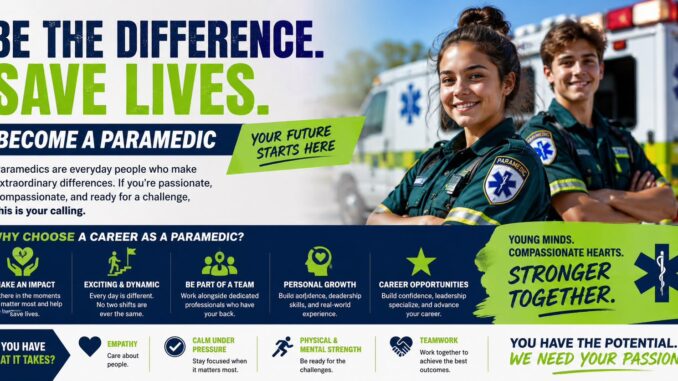
South Africa needs more paramedics. That is not a statement made loosely it reflects a reality that provincial emergency medical services, private ambulance operators, and healthcare institutions deal with every single day. The demand for trained, registered, and competent emergency care professionals has been growing steadily, and 2026 has brought with it a wave of recruitment and training opportunities for young South Africans who are ready to answer that call.
If you have been sitting on the idea of becoming a paramedic, wondering whether it is the right career, whether you qualify, or how the training actually works this guide is written specifically for you. It covers the full picture: what the career involves, the different training levels available, who can apply, what the process looks like, and how to protect yourself from fraudulent schemes targeting job-seekers in this space.
What Does a Paramedic Actually Do?
Before committing to any training path, it is worth understanding what the job actually demands on a daily basis. A paramedic is a pre-hospital healthcare professional. Their primary role is to respond to emergency calls medical crises, road accidents, workplace injuries, cardiac events, obstetric emergencies, and more and provide immediate clinical care before and during transport to a medical facility.
Unlike a nurse or doctor who operates in a controlled hospital environment, a paramedic works in the field. That means arriving at a scene with incomplete information, making rapid clinical decisions under pressure, sometimes in dangerous or physically demanding conditions, and being responsible for a patient’s life from the moment you arrive on scene until you hand them over at the emergency room.
The scope of what a paramedic can do depends heavily on their qualification level and in South Africa, that distinction matters enormously, both in terms of what you are permitted to do clinically and how much you earn.
The Three Training Levels You Need to Understand
South Africa’s emergency care training framework, regulated by the Health Professions Council of South Africa (HPCSA), has shifted significantly over the past decade. The old system of Basic Ambulance Assistants and Ambulance Emergency Assistants has been replaced with an NQF-aligned progression structure that allows practitioners to build their qualifications systematically from one level to the next.
Emergency Care Assistant (ECA) — This is the entry-level qualification, completed over one year at an accredited training institution. It provides foundational emergency care skills and prepares graduates for supervised practice within EMS operations. Graduates at this level handle basic life support interventions including CPR, bleeding control, airway management, and patient assessment. This is the starting point for most people entering the field without prior medical experience.
Diploma in Emergency Medical Care — A two-year programme offered at accredited colleges and some private institutions. Candidates who have already completed the ECA qualification can complete this diploma in one year rather than two. Graduates of this programme register with the HPCSA as Paramedics and are equipped for intermediate and advanced patient care interventions, including intravenous therapy, defibrillation, and advanced airway management. This qualification opens the door to most full-time employment roles in both government EMS and private emergency services.
Bachelor of Emergency Medical Care / Bachelor of Health Sciences in Emergency Medical Care — A four-year degree offered at universities and universities of technology. This is the highest paramedic qualification available in South Africa, sitting at NQF Level 8. Graduates register as Emergency Care Practitioners (ECPs) and are authorised to provide the full spectrum of Advanced Life Support care independently. This degree-level pathway also opens routes into management, education, research, and specialised rescue operations.
Understanding where you fit in this framework is the first step before applying anywhere.
Who Can Apply for Paramedic Training in 2026?
Requirements vary between institutions and qualification levels, but the following represent the standard criteria applied across most accredited EMS training programmes in South Africa for 2026.
For the Emergency Care Assistant programme, candidates typically need a matric certificate (Grade 12 or NQF Level 4), a valid driver’s licence (Code 10 / Code C1 is preferred by most employers and training providers, along with a Professional Driving Permit), proof of medical fitness, and no disqualifying criminal record. Mathematics and Life Sciences as matric subjects are beneficial but not always mandatory at this entry level.
For the Diploma in Emergency Medical Care, academic requirements are more specific. Institutions generally require a matric pass with English at 60%, Mathematics at 50%, Physical Sciences at 50%, and Life Sciences at 50%, along with a minimum APS score of around 26. A valid driver’s licence is required. Prior ECA qualification reduces the programme to one year.
For the Bachelor of Emergency Medical Care, the same academic benchmarks as the Diploma apply, with a minimum APS score of 26 and the same subject requirements. This is a full university degree programme and admission requirements are managed directly by the institution.
Across all levels, physical fitness is non-negotiable. EMS work is physically demanding lifting patients, working in confined spaces, managing scenes alone while awaiting backup and training programmes reflect this. Being in good physical condition before you apply is a practical investment, not just a nice-to-have.
Where to Apply: Institutions and Employers Recruiting in 2026
Several institutions and emergency services organisations are actively recruiting for paramedic training in 2026. These include provincial government EMS departments across Gauteng, the Western Cape, KwaZulu-Natal, and the Eastern Cape, as well as private operators and accredited training providers.
On the private side, ER24 and Netcare 911 are among the largest private emergency services employers in South Africa. Both regularly recruit qualified paramedics and EMS graduates and operate their own careers portals. ER24 directs candidates to their official careers portal at careers.er24.co.za, while Netcare 911 posts vacancies through the Netcare Group’s recruitment channels.
Provincial government EMS departments advertise trainee and learnership positions through the relevant provincial health department websites and the DPSA (Department of Public Service and Administration) vacancy portal at dpsa.gov.za. Learnerships attached to provincial EMS are registered with the relevant SETA and are often fully funded, meaning no tuition fees for qualifying candidates.
Accredited private colleges and training institutions offering the ECA and Diploma programmes include providers registered with both the HPCSA and SAQA. Always verify that any institution you apply to holds current HPCSA accreditation before paying any fees or signing any agreement.
How to Apply and what you will need
The application process differs depending on whether you are applying for a government learnership, a private employer training intake, or direct enrolment at a training institution. Here is how each pathway generally works.
For government EMS learnerships: Monitor the DPSA vacancy circular at dpsa.gov.za and your provincial health department’s official website. Applications are submitted through the online e-Recruitment portal or as specified in the advertisement. Attach certified copies of your ID, matric certificate, driver’s licence, and a professional CV. Submit before the closing date late applications are not considered.
For private employers like ER24 or Netcare 911: Register on their official careers portals and apply directly to advertised positions. These employers conduct their own multi-stage selection processes including aptitude tests, physical assessments, medical examinations, and interviews.
For direct enrolment at a training college: Contact the institution directly through their official website or admissions office. Request a prospectus, confirm HPCSA accreditation, verify the fees and funding options, and complete their application form with all required documents. Many institutions have rolling intakes, meaning you do not necessarily have to wait for a single annual window.
In all cases, prepare your documents in advance certified ID, certified matric certificate, driver’s licence, proof of residence, and a concise, well-written CV that highlights any healthcare, first aid, community service, or physically demanding work experience you have.
Salary Expectations After Qualifying
Understanding what the career pays gives context to the investment you are making. Salary figures vary by employer, province, and qualification level, but the following ranges reflect the general market for 2026.
Entry-level practitioners (ECA level) working in private or government EMS typically earn in the range of R8,000 to R12,000 per month. Mid-level practitioners holding the Diploma in Emergency Medical Care and registered as Paramedics typically earn between R14,000 and R22,000 per month depending on the employer, operational area, and experience. Senior-level Emergency Care Practitioners holding the degree-level qualification can earn between R22,000 and R40,000 per month, with government positions offering additional benefits including pension, medical aid, and housing allowances.
Overtime, shift allowances, and hazardous duty pay add to base earnings in most EMS roles, and career progression into supervisory, training, or management roles further increases earning potential over time.
Scams Targeting Aspiring Paramedics: Stay Alert
Fraudulent recruitment advertisements have become a genuine problem in the South African jobs market, and the healthcare sector is not immune. Fake paramedic training offers and EMS learnerships are regularly circulated on WhatsApp, Facebook, and TikTok often using logos of legitimate institutions to appear credible.
The safeguards are straightforward. Never pay a placement fee to secure a training position or learnership spot. Legitimate government learnerships are free. Legitimate private training institutions have transparent, published fee structures on their official websites. If someone contacts you through social media offering a guaranteed placement in exchange for money, that is a scam report it and walk away.
Always verify the HPCSA accreditation status of any institution before committing. The HPCSA maintains a public register of accredited training providers at hpcsa.co.za. If the institution is not on that register, do not enrol.
Is Paramedic Training the Right Path for You?
This is an honest question worth sitting with before you apply anywhere. Paramedic work is genuinely rewarding few careers offer the combination of immediate, tangible impact on people’s lives that emergency medical care provides. But it is also emotionally, physically, and mentally demanding in ways that are difficult to fully appreciate until you are in the field.
Shift work, including nights, weekends, and public holidays, is the standard. Exposure to traumatic incidents is regular. The physical demands are real. The responsibility is enormous. If you are someone who performs well under pressure, communicates clearly in stressful situations, genuinely wants to serve people in their most vulnerable moments, and has the resilience to manage the emotional weight of the work this career will suit you well and reward you for it.
If you are not sure, seek out a ride-along opportunity with your local EMS service or speak to working paramedics in your community before committing to a full training programme.
Useful Official Resources
- HPCSA (Health Professions Council of South Africa): hpcsa.co.za
- DPSA Vacancy Portal: dpsa.gov.za
- ER24 Careers Portal: careers.er24.co.za
- SAESI (SA Emergency Services Institute): saesi.com
Disclaimer
The information in this article is provided for general educational and informational purposes only. Training requirements, salary figures, application processes, and institutional offerings are subject to change. Readers are advised to contact relevant institutions, employers, and official bodies directly to verify current details before making any application or financial commitment. This article does not constitute professional career advice. For the full terms governing content on this website, please refer to our Disclaimer page.

Leave a Reply