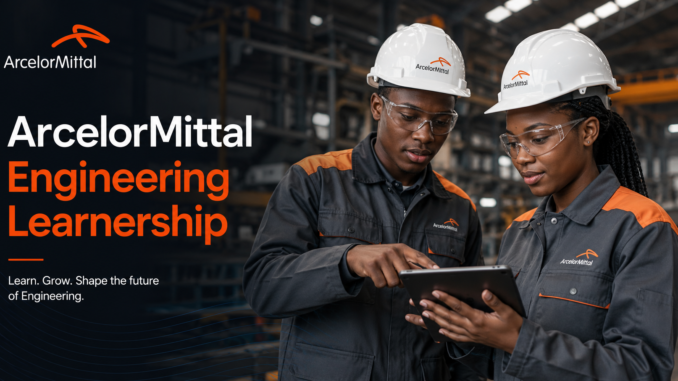
Steel holds the world together. It is in the bridges you cross, the vehicles you drive, the buildings where you work, and the pipelines that carry water to millions of homes across South Africa. Behind all of that sits one company ArcelorMittal South Africa and behind that company sits a workforce of technically trained professionals who know exactly how steel is made.
If you are a young South African with a passion for engineering, a strong academic foundation, and the desire to work inside one of the most demanding and rewarding industrial environments on the continent, the ArcelorMittal Engineering Learnership for 2026 is a programme worth understanding deeply before you apply.
The Company Behind the Opportunity
ArcelorMittal South Africa is the largest steel producer on the African continent. Operating as part of the global ArcelorMittal group which spans operations across more than 60 countries the South African arm produces approximately five million tonnes of liquid steel annually, supplying both flat and long steel products across hundreds of grades to manufacturers, construction companies, and infrastructure developers throughout the region.
The company’s operations are anchored in two major South African locations: Vanderbijlpark in Gauteng and Newcastle in KwaZulu-Natal. These are not small workshops. They are vast industrial plants where advanced engineering systems, high-voltage electrical infrastructure, precision instrumentation, and complex metallurgical processes run simultaneously around the clock.
ArcelorMittal South Africa is guided by a core value the company calls “We Care” a commitment to safety, zero harm, and the wellbeing of every person on its operations. For candidates considering the engineering learnership, this value is not decorative language. It is a standard that shapes how work gets done on the floor every day, and it is one of the first things every learner is trained in from day one.
What the Engineering Learnership Actually Covers
The ArcelorMittal Engineering Learnership for 2026 takes the form of a Work Integrated Learning Programme (WIL). This is distinct from a standard entry-level learnership. Rather than targeting matriculants, the WIL programme is specifically designed for students who have completed their S5 level of study at a South African University of Technology and are pursuing an engineering diploma.
The programme runs for twelve months on a fixed-term contract basis and is structured to fulfil the workplace practical requirements that universities of technology build into their engineering diploma curricula. In other words, this learnership counts towards the qualification you are already working toward it is not a detour from your studies but a direct contribution to completing them.
Training takes place across the following engineering disciplines:
Electrical Engineering involves working with high-voltage systems, industrial automation, motor control circuits, switchgear, and the maintenance of the electrical infrastructure that keeps a steel plant operational. The scale and complexity of electrical systems inside an ArcelorMittal facility is not something a textbook can fully prepare you for this is where classroom theory meets real industrial voltage.
Instrumentation Engineering focuses on process control systems, sensor calibration, monitoring equipment, and the instrumentation technology that measures and regulates every variable inside a steel production environment from furnace temperatures to flow rates and pressure readings.
Mechanical Engineering covers the maintenance, inspection, and troubleshooting of heavy industrial machinery, conveyors, hydraulic systems, and mechanical structures that are fundamental to continuous production.
Chemical Engineering and Metallurgical Engineering deal with the material science behind steel itself understanding how different alloying elements behave at extreme temperatures, how process chemistry affects product quality, and how to optimise the metallurgical outputs of a working blast furnace or basic oxygen furnace.
Industrial Engineering addresses efficiency, workflow optimisation, production planning, and the operational systems that keep a large manufacturing facility running without unnecessary downtime or waste.
Who the Programme Is Designed For
The engineering learnership targets final-year diploma students at South African universities of technology, not general job seekers. To be considered, you need to have completed your S5 level of study in one of the disciplines listed above, maintain a solid academic record, and be available for full-time workplace training at either the Vanderbijlpark or Newcastle site.
Beyond academic standing, ArcelorMittal looks for candidates who can communicate clearly, function effectively within a team, solve problems under pressure, and demonstrate a genuine commitment to safety and professional conduct. Heavy industry is not a passive learning environment. You will be expected to engage actively, follow strict operational protocols, and take your responsibilities seriously from the moment you walk onto the site.
For the production-focused learnership stream which targets matriculants rather than engineering students the entry requirements differ slightly. That programme requires a complete Grade 12 with passes in Mathematics, Science, and English at minimum Level 3, and preference is given to South African youth under the age of 35. Successful candidates for that stream enter a 36-month learnership agreement to train as Process Operators at the Vanderbijlpark Works.
Across both programmes, applicants must be prepared to pass an industrial medical examination before placement is confirmed. This is standard practice in heavy manufacturing and reflects the physical demands and safety requirements of working inside a large-scale steel production facility.
The Structure of Learning Inside ArcelorMittal
What makes this programme different from other South African learnerships is the depth of the industrial environment you are dropped into. This is not a corporate office rotation or an administrative attachment. Learners work inside active production areas, alongside engineers who have spent years navigating the same challenges you will be studying.
Each learner is assigned a dedicated engineering mentor an experienced professional whose role is to guide, challenge, and support you through the twelve months of the programme. The mentor relationship is intentional and structured. You are not left to observe from a distance. You are expected to contribute, ask questions, apply the theory you have already studied, and develop professional habits that carry forward into your career.
The theoretical component runs parallel to workplace training. Assessments are conducted regularly to measure competency development, and progress is tracked to ensure learners are advancing toward the qualification outcomes required both by ArcelorMittal and by the learner’s university of technology.
Remuneration during the programme is market-related, acknowledging the skill level and academic investment of participants. The twelve months are not unpaid exposure they are compensated professional development.
Protecting Yourself From Fraudulent Offers
This is a point that deserves direct attention. ArcelorMittal South Africa does not charge any fees at any stage of the application or placement process for its learnerships or apprenticeships. If you are ever contacted by an individual or a third-party service claiming to offer you a guaranteed placement in an ArcelorMittal programme in exchange for a payment of any kind, that is a scam.
All genuine recruitment communications come directly from ArcelorMittal or through the company’s official online recruitment platform. The company also uses a recorded video interview system called Wamly during its shortlisting process make sure to monitor your email account carefully after applying, as missed interview requests can cost you a confirmed position.
Why an Engineering Learnership at ArcelorMittal Carries Real Weight
South Africa needs technically trained engineers. The country’s infrastructure backlog, energy challenges, and manufacturing ambitions all point toward a sustained demand for people who understand how industrial systems work and can operate, maintain, and improve them.
A learnership completed inside ArcelorMittal’s operations gives you something that many engineering graduates lack at the point of entering the job market: verifiable, large-scale industrial experience. You will have worked with equipment that most engineering graduates only read about. You will understand what happens when a production system fails, how experienced engineers diagnose problems under operational pressure, and what it actually takes to maintain safety and quality standards in a 24-hour manufacturing environment.
Employers across South Africa’s manufacturing, mining, energy, and construction sectors recognise ArcelorMittal’s training standards. A 12-month WIL programme completed at one of its facilities is not a footnote on your CV it is evidence of technical capability tested in one of the most demanding industrial environments in the country.
How to Position Your Application Correctly
Engineering learnerships at ArcelorMittal attract strong competition. Every applicant who meets the academic entry requirements will be presenting similar qualifications, which means the differentiating factors often come down to how well you communicate your motivations, your readiness to work in a high-safety environment, and your understanding of what the company actually does.
Before submitting your application, take time to understand the specific discipline you are applying for and how your academic background relates to the work done inside that department. A candidate who can clearly articulate why Instrumentation Engineering at a steel plant is relevant to their diploma studies, and what they hope to contribute and learn, will stand out above someone who treats the application as a form-filling exercise.
Make sure your academic transcripts are updated, your CV reflects your current S5 standing, and your contact details are accurate. Given that ArcelorMittal uses digital interview platforms, a non-functional email address or missed notification can end your candidacy before any formal review takes place.
Requirements and programme details may be updated by ArcelorMittal South Africa between intake cycles. Always verify current specifications on the official ArcelorMittal South Africa careers portal before submitting your documents.
Leave a Reply