Programme Insight
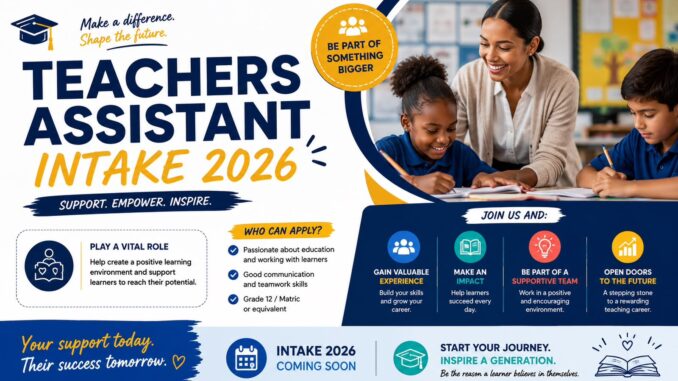
Schools in South Africa need support and the government has created a structured, funded pathway for unemployed youth to provide exactly that. If you are between the ages of 18 and 35, hold a matric certificate, and are not currently employed or studying full-time, the Teacher Assistant programme may be one of the most practical and accessible opportunities available to you in 2026.
This is not a vague promise or a social media rumour. It is a government-backed initiative that has already created over one million work opportunities for young South Africans across multiple phases and the next phase is coming. This guide explains what the programme is, what it offers, who qualifies, what you will actually be doing day to day, how to apply correctly, and what to do right now to make sure your application is ready when the window opens.
The Programme Behind the Opportunity: Understanding BEEI
The Teacher Assistant programme in South Africa operates under the Basic Education Employment Initiative, commonly referred to as the BEEI. It is part of the broader Presidential Youth Employment Initiative a government-led effort to address youth unemployment by placing young people in public schools across all nine provinces.
The BEEI is administered by the Department of Basic Education in partnership with the SA Youth platform and implemented with support from the Industrial Development Corporation, which manages stipend disbursements. Since its launch, the initiative has moved through multiple phases, with each phase creating tens of thousands of placement opportunities for qualifying youth. Phases I through IV alone created more than 1.1 million job opportunities for youth across South Africa.
Phase 6 of the BEEI is expected to once again provide unemployed youth with school-based experience, focusing on classroom support, reading programmes, ICT assistance, and general school administration across public schools nationwide. The programme is not a permanent job, but for many young people it has been the foundation that made everything else possible the first reference on a CV, the first taste of workplace responsibility, and in many cases the first step toward a career in education.
Two Types of Roles You Can Apply For
One of the things that makes this programme accessible to a wide range of young people is that it does not offer just one kind of position. There are two distinct roles available, each with slightly different requirements and responsibilities.
Education Assistant (EA) — This is the more popular of the two roles and the one most people refer to when they talk about being a teacher assistant. Education Assistants are placed directly inside classrooms to support qualified teachers with daily learning activities. This includes assisting with classroom management and lesson preparation, supporting learners with reading, writing, and numeracy, helping supervise learners during breaks and school activities, facilitating learning for learners with barriers to education, and providing administrative support such as marking, filing, and organising materials. You are not a teacher you do not plan lessons or formally assess learners. Your role is to be the extra pair of hands and eyes that helps the teacher run a more effective, supportive classroom. For the EA role, a matric certificate with a pass in English is the standard minimum requirement. Candidates with post-school qualifications such as a diploma or degree are given preference during shortlisting.
General School Assistant (GSA) — This role focuses on broader school support rather than direct classroom involvement. General School Assistants assist with administrative tasks, school maintenance, safety monitoring, and general operational support that keeps the school functioning smoothly. Some GSA roles may not require a matric certificate, making this pathway accessible to candidates who have not yet completed their Grade 12.
Both roles are temporary contract positions, typically running for five to six months per phase, and both come with a monthly stipend.
What the Stipend Looks Like
Money matters, and it is fair to want to know what you will earn before committing your time to any programme. In Phase 6, teaching assistants are expected to receive a monthly stipend of R4,000 for six months, along with R30 for data. Stipend payments are made on the last working day of each month, and a pro-rata amount applies if you do not work a full calendar month.
While R4,000 per month is modest, it comes with a benefit that goes beyond the cash: UIF registration. Participants are entitled to UIF benefits after their contract ends you can register at your nearest Labour Centre with your ID and payslips once the placement concludes. That means when the contract is over, you are not simply left with nothing. You have a formal employment record, a UIF contribution history, and a workplace reference all of which carry real value in your next job application.
Who Qualifies to Apply?
The programme is targeted specifically at unemployed youth, and the eligibility requirements reflect that purpose. Here is what you need to qualify.
You must be a South African citizen between the ages of 18 and 35. The programme targets youth aged 18 to 34, specifically those who will not turn 35 before the end of the relevant programme period. You must be unemployed not working, not studying full-time at a registered institution, and not receiving any other government grant or income support. You must hold a matric certificate (Grade 12 or NQF Level 4 equivalent) for the Education Assistant role, with English being a required subject pass. You must reside close to a school within your community, as placements are made based on proximity to minimise transport challenges. You must have no criminal record applicants who are shortlisted are required to provide an affidavit confirming this while awaiting formal police clearance.
There is no requirement for prior teaching experience or work experience of any kind. This programme is accessible to many young people who are entering the job market for the first time. What matters is your willingness to show up consistently, your patience with learners, and your commitment to contributing meaningfully within a school environment.
How to Apply: The SAYouth.mobi Process
The application process for this programme is entirely online and is managed through a single official platform: SAYouth.mobi. There are no walk-ins at schools, no hand-delivered applications, and no postal submissions. If someone tells you otherwise, treat it as misinformation.
Here is how the process works in practice.
Step one is to visit SAYouth.mobi and create your profile if you have not done so already. The platform is zero-rated, meaning you can access it without using your mobile data an important accessibility feature for youth in lower-income communities. Complete your profile fully and accurately. Every field matters because your digital profile functions as your CV on this platform. There are no separate documents to upload unless the system or a specific school specifically requests them.
Step two is to ensure that your GPS location is enabled on your device when you access the platform. The system uses your location to match you with available schools in your immediate area. Schools prioritise applicants who live nearby, so accuracy here is in your best interest.
Step three is to apply to schools near your home. When the application window for the relevant phase opens announced through the Department of Basic Education’s official channels and SAYouth.mobi you will be able to browse and apply to available positions at schools close to your residential address. Apply early. Do not wait until the final days of the application period, as positions at popular schools fill up quickly.
Step four is to keep your phone accessible and check your notifications regularly after applying. Shortlisted candidates are contacted via the platform, and response time matters. If you are called for an interview or required to submit documents and you do not respond promptly, your opportunity may be given to the next candidate.
What the Role Looks Like in Real Life
Many people apply for the Teacher Assistant programme with limited knowledge of what the working day actually involves. Understanding this upfront helps you decide whether it is the right fit and prepares you to perform well from day one.
Your working hours align with school hours typically from around 07:30 in the morning until the end of the school day in the afternoon, five days a week. You will work under the direct supervision of a qualified teacher, which means your role is supportive and collaborative rather than independent.
In a reading support context, you might work one-on-one or in small groups with learners who are struggling with literacy, using structured resources provided by the school or the Department of Basic Education. In a general classroom support context, you might be helping to distribute materials, assist a learner with special needs, monitor group work, or manage paperwork while the teacher leads instruction.
Beyond the classroom, you may be involved in playground supervision, helping with school events, supporting the administration office, or assisting with ICT tasks if you have relevant skills. Every day looks slightly different, and the variety is one of the aspects of the role that many assistants find genuinely rewarding.
The experience you build over five to six months in a school is transferable in more ways than most people expect. It teaches punctuality, interpersonal communication, patience, adaptability, and professional conduct in a way that no short course can replicate.
What Comes After the Contract Ends?
The end of a BEEI contract is not a dead end it is a launching pad, provided you approach it strategically. Here is how to make the most of what you will have gained.
Update your CV immediately. Add the school name, the role title, the dates of your placement, and a brief description of your duties. This is now formal work experience, and it belongs on your CV. Ask the school principal or your supervising teacher for a written reference letter while the placement is fresh this is standard practice and most schools are willing to provide one.
Consider using the experience to apply for further training in education. Many former BEEI participants have gone on to study at TVET colleges or universities to become qualified teachers, using their practical classroom exposure as motivation and their stipend savings to fund the initial application costs.
If teaching is not your long-term direction, the professional skills gained in a school environment communication, administration, patience, reliability are valued across public service, NGOs, social development, and community health roles.
Avoiding Scams and Protecting Yourself
The Teacher Assistant programme’s popularity has made it a target for fraudulent recruitment posts, particularly on WhatsApp, Facebook, and TikTok. These posts often claim to be from the Department of Basic Education or from specific schools, and they ask applicants to pay a fee, send copies of their ID to unknown numbers, or apply via unofficial links.
The programme is completely free. No fees are required when applying. Any request for money regardless of how official it looks is a scam. Applications go through SAYouth.mobi only. The Department of Basic Education communicates through its official website at education.gov.za and its verified social media accounts. Nothing else should be trusted without verification against those sources.
Key Official Resources for the job
- Applications Portal: SAYouth.mobi
- Department of Basic Education: education.gov.za
- BEEI Updates on Twitter/X: @DBE_BEEI
Terms and Conditions
The content on this website is published for general informational purposes. By accessing and using this article, you agree to the terms that govern this website. Please read our full Terms and Conditions before relying on any information published here. Programme details including stipend amounts, eligibility criteria, and application dates are subject to change at the discretion of the Department of Basic Education and relevant implementing agencies. Always verify current information through official government platforms before applying.

Leave a Reply